Madagascar vanilla captivates the whole world with its rich, delicate aromas. Yet behind this precious spice lies an unstable market, marked by spectacular surges and sometimes brutal drops.
Between 2020 and 2026, the vanilla market changed dramatically. Understanding these fluctuations also means discovering the realities faced by Malagasy producers and the challenges of an iconic industry.
Madagascar, land of vanilla excellence
Madagascar is among the world’s leading producers of natural vanilla. The SAVA region in the northeast of the island is particularly renowned for its Bourbon vanilla, prized for its warm, rounded, and indulgent notes.
Its cultivation requires exceptional know-how: each flower is typically pollinated by hand, and the pods then require several months of preparation, drying, and curing before revealing their aromas.
A meticulous process that adds to the value of this spice.
A vanilla market dominated by the United States
The United States, France, and Germany are the world’s top three importers of vanilla. About 80% of Madagascar’s vanilla is exported to the United States, making it the world’s leading importer. The U.S. notably imports red-grade vanilla for extraction to produce natural vanilla extracts and flavorings.
A study carried out in 2006 indicated that around twenty companies accounted for 98% of the global vanilla market, mainly 10 American firms, 5 French, and 2 German. However, this dynamic is changing today. More and more European countries (other than France and Germany) are importing vanilla. Asia is also gaining ground in the global vanilla landscape, notably with Japan and China.
An unstable market subject to climatic hazards and speculation
The relatively small vanilla market is vulnerable to climate hazards and speculation. Vanilla periodically goes through cycles of overproduction. Cyclones that frequently hit Madagascar’s eastern coast (the global birthplace of vanilla) can destroy a significant share of vanilla plantations or the annual harvest. In a context of opacity—where even the announcement of production forecasts is used to influence price levels—it is therefore difficult to know the figures with any certainty.
Vanilla price trends between 2020 and 2026
After several years of high prices, the market experienced a significant downturn, driven in particular by increased supply and the buildup of inventories.
Here is an indicative overview of the evolution of Madagascar’s average export values:
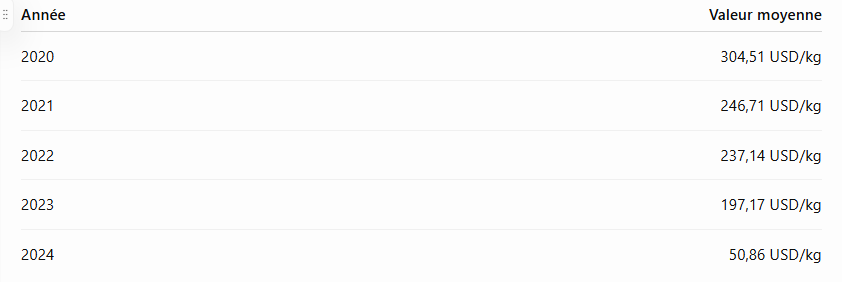
USD per kilogram. Sources: UN Comtrade data as cited by Selina Wamucii, the Central Bank of Madagascar, and 2026 FOB references. The last two rows are not directly comparable to the annual averages. Sources : Selina Wamucii
In 2026, prices remain variable depending on quality, grade, and commercial terms. As an indication, a September 2026 reference placed unsplit black vanilla at around USD 64/kg FOB.
These data are not directly comparable, but they illustrate the market’s transformations.
Why does the price of vanilla fluctuate?
Five factors mainly influence prices:
Climate: cyclones, droughts, and excessive rainfall can jeopardize crops.
Supply and demand: abundant production and high inventory levels are putting downward pressure on prices.
Speculation: buying and stockpiling strategies sometimes amplify price fluctuations.
Export regulations: export policies influence market conditions.
Competition: other producing countries and substitute flavorings are reshaping demand.
Behind the prices, the reality of producers
In Madagascar, vanilla represents far more than a spice: it is an essential source of income for many rural families.
When prices fall, producers can experience a significant drop in income, despite the months of work required to grow and prepare the pods.
Behind each vanilla pod lie skilled hands, preserved traditions, and a human story that deserves to be highlighted.
What outlook for 2027?
The future of the market will depend on the balance between harvests, available stocks, and international demand.
While the growing interest in natural ingredients, traceability, and authentic products represents an opportunity, price movements remain uncertain.
Quality, origin, and responsible business practices could become increasingly important differentiating factors.
A market supported by the growing demand for natural and organic food products
Consumers today are increasingly demanding and pay closer attention to the composition of the products they consume and use. They are calling for greater transparency, both about the origins of these products and about the socio-cultural and environmental context in which they are produced.
Several articles on the Internet have revealed the ingredients used to make artificial vanilla flavorings. These are said to be made from catechol derived from petroleum, castoreum, and so on.
Matana’s vanilla, sold in Quebec and across Canada, is 100% natural and has undergone no industrial processing. It is prepared using traditional, fully manual methods, with no preservatives. Our suppliers are selected according to strict criteria and must also contribute to the development of their community.
Vanilla: a Multi-Purpose Product
Vanilla is one of the most well-known and widely used spices in the world. It is found in particular in the following industries:
Food products and beverages
Vanilla is a flavor enhancer mainly used in the following areas: baking, dairy products (yogurt, ice cream, etc.), beverages, confectionery, and dietary supplements.
Cosmetics and personal care
Vanilla is used in cosmetic products for its pleasant aroma, which is both soothing and stimulating. Beyond its delightful fragrance, vanilla also offers skin benefits: an outstanding anti-aging treatment, moisturizing, softening, antioxidant, and skin-repairing.
Pharmaceutical products
Vanilla, in the form of natural or artificial flavoring, is increasingly used in the pharmaceutical field. It gives these products a gourmet touch and a comforting scent. Vanilla also offers benefits for the nervous system.

MATANA: Madagascar Vanilla — Beyond the Price
At MATANA, we believe that the true value of vanilla lies as much in its aromatic richness as in its origin and the expertise of those who cultivate it.
Our ambition is to showcase Madagascar’s authentic flavours across Quebec and Canada, while celebrating the traditions and talents of the Great Island.
From our vanilla pods to our vanilla powder, we invite culinary enthusiasts and professionals to discover an exceptional spice.
Because an exceptional vanilla is more than just its price: it tells the story of a land, a craft, and a heritage.
Discover MATANA’s hand-selected Madagascar vanillas and let their aromas elevate your gourmet creations.


